


Key Highlights
- GJSCI and NSDC organised Future Facets 2026 in Mumbai.
- More than 50 industry stakeholders participated in the consultation.
- AI, CAD, digital production and ESG compliance emerged as major future skill priorities.
- IIT Madras introduced Diamondtronics, highlighting new technology applications for lab-grown diamonds.
- Apprenticeship programmes such as NAPS-2 and PM-SETU were highlighted for jewellery MSMEs.
- The workshop identified growing demand for setters, casters, CAD professionals and gemstone specialists.
- Industry leaders said ESG credibility now requires measurable evidence rather than policy declarations.
- Digital systems and ERP were highlighted as essential for traceability and compliance.
The Gem & Jewellery Skill Council of India (GJSCI), in partnership with the National Skill Development Corporation (NSDC), organised “Future Facets 2026 – Industry Consultation Workshop” at Bharat Ratnam Mega CFC, SEEPZ, Mumbai. The day-long workshop brought together close to 50 plus stakeholders from across the gem and jewellery sector to identify emerging skilling needs as well as opportunities for the sector at large to strengthen the sector’s future competitiveness.
Future Facets is the 1st industry consultation workshop organized by GJSCI for engagement, dialogue and consultation within the gem and jewellery sector. This year’s workshop examined the combined impact of technological advancement, digital transformation, evolving customer expectations, global trade requirements and rising environmental, social and governance (ESG) expectations.
The discussions underlined that the industry’s future will depend not only on the availability of manpower, but also on the quality, relevance and adaptability of skills across the value chain.
Stakeholders discussed current and emerging requirements in manufacturing, traditional craftsmanship, CAD and digital production, retail, wholesale, gemstone processing, quality assurance, traceability, compliance and leadership.
In his opening remarks, Rajeev Garg, Executive Director & CEO, GJSCI, highlighted the need to move beyond a manpower-focused approach towards a continuous workforce-development model that supports the long-term sustainability of the sector. He emphasised the importance of professionals who can combine craftsmanship with technology, technical expertise with commercial understanding, and experience with a commitment to continuous learning.
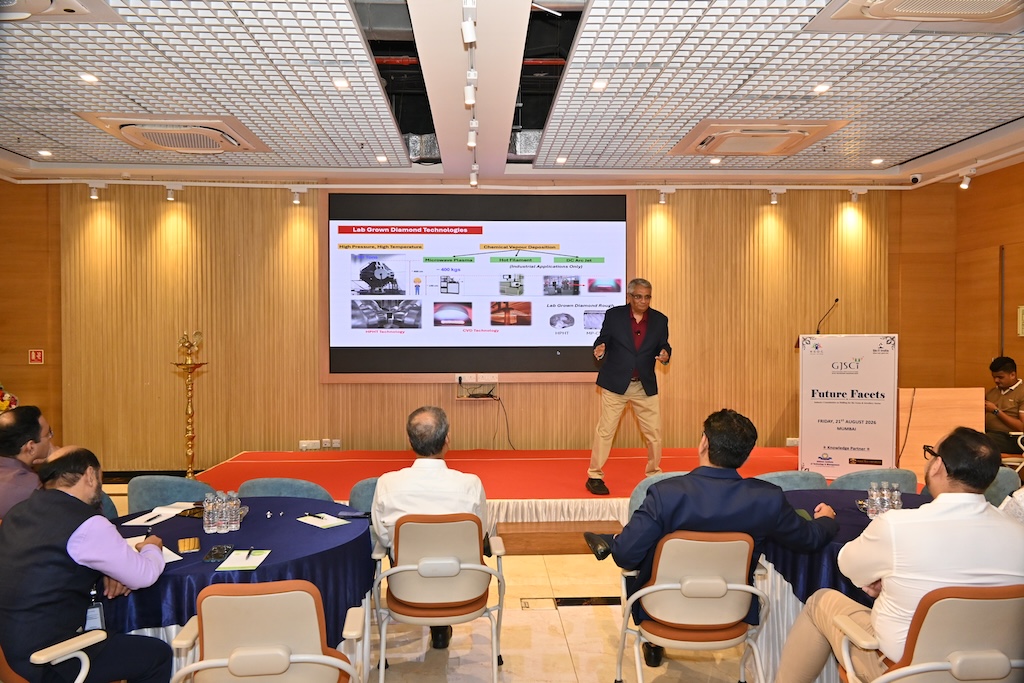
The opening session on Future Trends and Emerging Skills featured Prof. M.S. Ramachandra Rao, Professor Emeritus, Department of Physics, IIT Madras, and Head of the India Centre for Lab Grown Diamonds (InCent-LGD). He introduced the concept of “Diamondtronics”, exploring the potential of laboratory-grown diamond and advanced materials in thermal management, advanced electronics, sensing, photonics, quantum technologies and future telecommunications.
Prof. Rao also discussed indigenous technology development, material characterisation, engineered defects and diamond-marking technologies that can support authentication and traceability. His presentation expanded the industry’s understanding of diamond—from a material valued primarily for adornment to one with potential applications across India’s emerging technology ecosystem.
The workshop also examined Digital and AI Adaptation in the Gem and Jewellery Sector, presented by Dhirendra Srivastava, Senior Data Scientist and Technical Lead. The session highlighted opportunities for artificial intelligence in retail customer experiences, demand forecasting, future design development and the mitigation of material loss in manufacturing.
Government-led skilling and apprenticeship initiatives for jewellery MSMEs formed another important part of the programme. Hemant D. Ganjare, Regional Director/HoD, Regional Directorate of Skill Development & Entrepreneurship, Maharashtra, outlined the potential of structured apprenticeship, NAPS-2 and PM-SETU to strengthen the connection between vocational education and workplace requirements.
The discussion emphasised that apprenticeship can become a strategic talent pipeline for jewellery businesses, particularly in production assistance, jewellery manufacturing, CAD/CAM operations, casting, polishing, quality control and machine operations. Formal workplace learning, supported by government mechanisms, can help MSMEs develop production-ready talent within their own processes, equipment and quality systems.
Ms. I.K. Mathuriya, Assistant Director, MSME, provided insights into government schemes, including PM Vishwakarma, aimed at empowering the sector through wider access to skilling and support. The discussion also highlighted the GJSCI–NSDC partnership in preparing and sending participants to WorldSkills competitions, with GJSCI participants achieving podium finishes each year.
In the post-lunch session, Rajeev Garg presented workforce skilling need gaps identified through interactions with industry stakeholders. The discussion covered shortages and capability requirements relating to setters, casters, CAD professionals, gemstone specialists, retail associates and digitally enabled business-development roles.
The session also emphasised the need to reskill karigars and artisans in digital-design interpretation, technical-sheet reading, weight and wastage control, quality consistency and modern production tools—without diluting the judgement, creativity and craftsmanship that define Indian jewellery.
Participants further highlighted the need for training in customs-related processes and documentation to support faster dispatch of consignments and the secure movement of valuable raw materials.
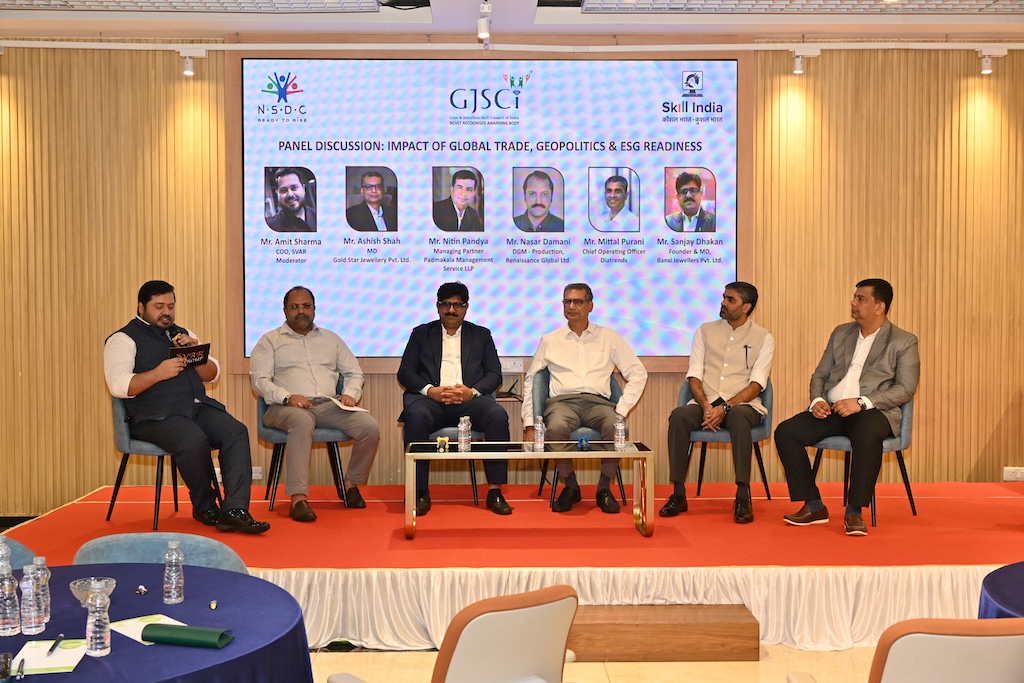
The workshop concluded with a panel discussion on “Impact of Global Trade, Geopolitics & ESG Readiness: Is the Jewellery Industry Ready?”
The panel comprised:
- Ashish Shah, Managing Director, GoldStar Jewellery.
- Sanjay Dhakan, Founder & Managing Director, Bansi Jewellers.
- Mittal Purani, Chief Operating Officer, Diatrends Jewellery.
- Nasar Damani, DGM – Production, Renaissance Global.
- Nitin Pandya, Managing Partner, Padmakala Management Services LLP.
The discussion was hosted by Amit Sharma, COO, SVAR Media.
The panel observed that international buyers are increasingly moving from asking whether a company has an ESG policy to seeking measurable evidence of its implementation. Traceability, employee welfare, community engagement, responsible sourcing and credible reporting are therefore becoming central to global market readiness.
In response to the question on the impact of trade policy shocks (US Tariffs) on the sector, the panel was of the opinion that these disruptions have become the new normal in the sector. The sector has demonstrated resilience of its own to deal with these issues while further being supported by the various Free Trade Agreements being signed by the Government of India.
Technology was identified as a key enabler of this transition. ERP and connected digital systems can strengthen traceability from the source of a gold purchase to the final customer while improving compliance, documentation and supply-chain visibility. The panel stressed that ESG credibility will increasingly depend on evidence, process discipline and verification rather than broad claims or declarations.
Future Facets 2026 positioned skilling not merely as a training function, but as an industry imperative. The consultation provided a platform for stakeholders to identify present requirements, anticipate future capability needs and strengthen collaboration among industry, government, academia and skill-development institutions.
The workshop reinforced a clear message: India’s next competitive advantage in gem and jewellery will come from a workforce that preserves the intelligence of traditional craftsmanship while confidently adopting new technologies, business models and global standards.
Related Coverage

Belgian Consul General Mr. Pierre Steverlynck Graces BDB Annual Day

Limelight Lab Grown Diamonds crosses 100-store milestone this Dussehra: targets 200 in 2027
IIGJ Mumbai Celebrates 79 Graduates, Showcasing Innovation and the Future of Jewellery Design

UNNATI: Building the Women Who Will Shape India’s Jewellery Future

GJS 2026 Diwali Edition to Bring 400+ Exhibitors to Mumbai from October 2–4