


GJEPC launches a national initiative to strengthen women’s skills, careers, entrepreneurship and leadership across the gems and jewellery value chain
Key Highlights
- GJEPC launches UNNATI, a national initiative focused on women’s skills, careers, entrepreneurship and leadership in the gems and jewellery industry.
- More than 1,100 women participated in the Surat launch, with the first phase targeting at least 200 women for skilling programmes.
- UNNATI is built around five pillars: Inspire & Engage, Develop & Empower, Connect & Collaborate, Enable & Accelerate, and Transform & Lead.
- The initiative supports India’s US$100 billion gem and jewellery export ambition by 2040 by strengthening women’s participation across the value chain.
- UNNATI also includes support for women Ratnakalars, including Parichay Cards and free medical insurance coverage of up to ₹1 lakh for 1,000 women in the first phase.
India’s ambition to become a US$100 billion gems and jewellery export powerhouse by 2040 will require more than investment, technology and market access. It will also require a stronger and more skilled workforce, with women playing a greater role across every level of the industry.
That is the larger context behind UNNATI – Powering Women in Gems & Jewellery, a national initiative launched by the Gem & Jewellery Export Promotion Council (GJEPC) in Surat on October 5, 2026.
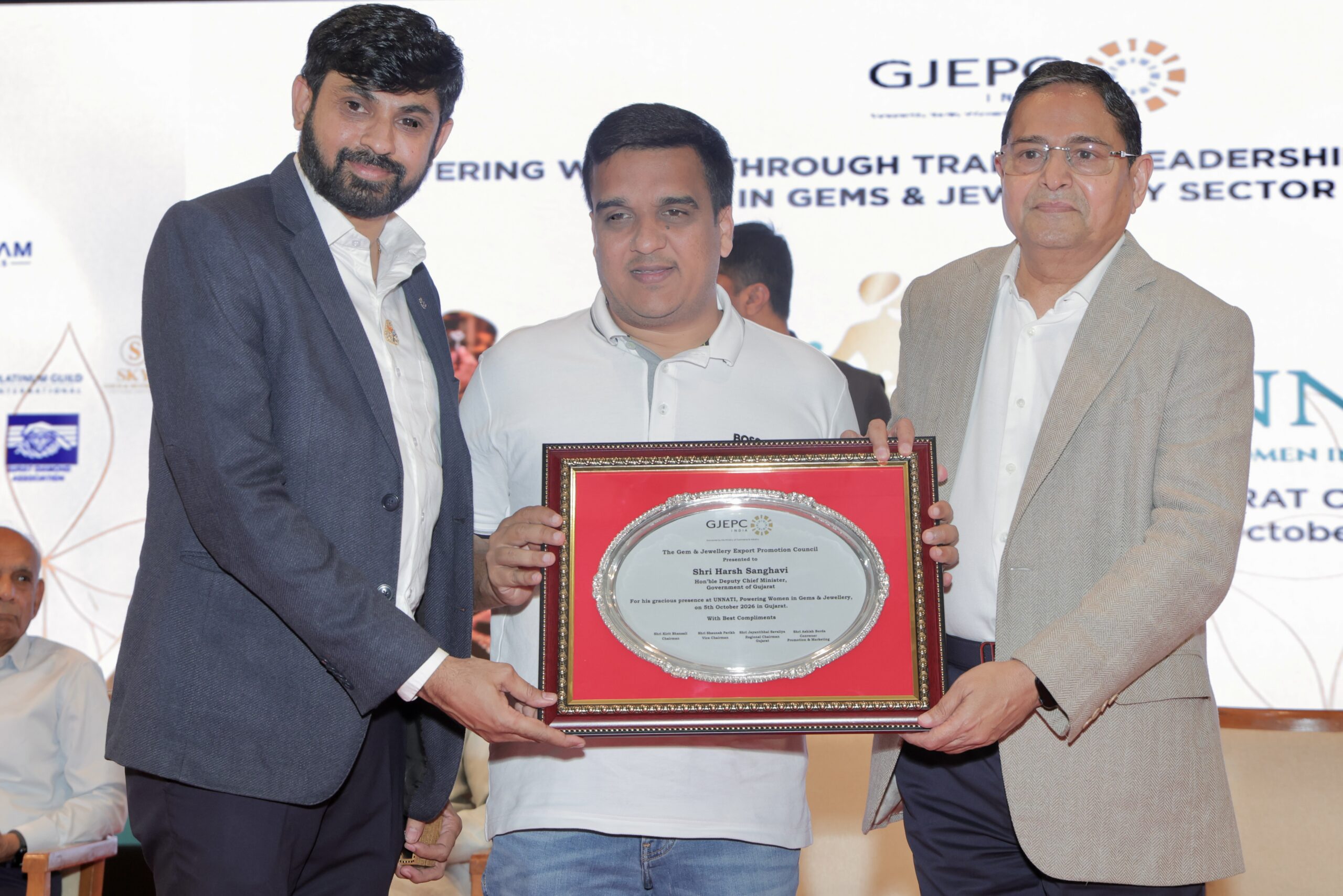
Launched at Sardar Patel Smruti Bhavan in the presence of Gujarat Deputy Chief Minister Shri Harsh Sanghavi and Rajya Sabha MP Shri Govind Dholakia, UNNATI aims to create opportunities for women to learn, lead and grow as skilled professionals, entrepreneurs and future leaders across the gems and jewellery value chain.
The initiative begins in Gujarat but has been conceived as a national mission. More than 1,100 women from the industry, homemakers and students participated in the Surat launch, while the first phase aims to register at least 200 women for skilling programmes.
From Participation to Leadership
Women are already present across India’s jewellery ecosystem — from manufacturing and design to retail, management, entrepreneurship and other professional roles. UNNATI seeks to build on that existing participation by creating clearer pathways for women to acquire skills, develop careers and move into leadership.
GJEPC describes the initiative not as a welfare programme, but as an investment in the future competitiveness of the industry.
The logic is straightforward: if India wants to significantly expand its global jewellery business, it will need to develop the full potential of its workforce.
The initiative is therefore linked directly to GJEPC’s ambition of achieving US$100 billion in gem and jewellery exports by 2040.
Shri Harsh Sanghavi, Hon’ble Deputy Chief Minister of Gujarat, said:
“Unnati is an important initiative that is creating meaningful opportunities for women in the gem and jewellery industry. Today, more than 1,000 women are being connected with employment and business opportunities, but the potential is far greater. We should look at taking these opportunities beyond Surat and into Gujarat’s rural and tribal areas, where greater participation by women can create a strong social and economic impact for their families and communities. I urge GJEPC to develop more initiatives that bring women into the industry and expand their participation across Gujarat. Unnati should not stop at 1,000 or 2,000 women. We should work towards reaching 10,000 women in the coming year. The women who have achieved success should also become role models for others, helping more women gain confidence, build careers and realise their ambitions.”
Five Pillars for Growth
UNNATI has been built around five pillars designed to take women from aspiration to achievement:
- Inspire & Engage — recognising and celebrating women’s contribution to the industry
- Develop & Empower — leadership, skills training and lifelong learning
- Connect & Collaborate — mentors, peer networks and an industry community
- Enable & Accelerate — support for business, funding and market opportunities
- Transform & Lead — safer and more progressive workplaces
The programme is also designed to connect participants with practical skills relevant to the jewellery trade. Training opportunities showcased at the launch include diamond assortment, diamond polishing, diamond planning, jewellery design through hand sketching and CAD, wax setting, filing and assembly, metal setting, jewellery polishing and cleaning, and retail sales.
This practical approach is significant. For an industry built on specialised craftsmanship and increasingly dependent on technical and professional skills, creating access to training can help widen the talent pool while also giving women clearer routes into employment and entrepreneurship.
Creating Opportunities Beyond the Workshop Floor
The initiative’s ambition extends beyond employment.
Shri Govind Dholakia, Member of Parliament, Rajya Sabha, said:
“UNNATI gives us the platform and the direction, but the real work begins with us. We must take this opportunity and create our own growth. I encourage young entrepreneurs, especially women, to have the confidence to step forward, take risks and build something of their own. There is tremendous opportunity in the gem and jewellery sector, and we need more women not only to participate in the industry, but to lead businesses, create employment and contribute to society. That is the kind of leadership and inclusive growth we need for the future.”
For GJEPC, the connection between women’s advancement and the industry’s export ambitions is central to the initiative.
Shri Kirit Bhansali, Chairman, GJEPC, said:
“Hon’ble Prime Minister Shri Narendra Modi’s vision of Viksit Bharat @ 2047 places Nari Shakti at the heart of India’s journey towards a stronger and more developed nation. As an industry, we have set ourselves an ambitious goal of achieving US$100 billion in gem and jewellery exports by 2040, and we cannot achieve this without fully harnessing the talent, skills and leadership of women. UNNATI is a step in that direction—to move women from participation to leadership, from skills to careers, and from employment to entrepreneurship. When women grow, our industry grows; and when women lead, they can accelerate our collective journey towards US$100 billion by 2040.”
Supporting Women Artisans
UNNATI also includes a specific welfare component for women Ratnakalars.
Under GJEPC’s Ratnakalar Parichay Card initiative, the first phase will provide 1,000 women Ratnakalars with Parichay Cards along with free medical insurance coverage of up to ₹1 lakh. The initiative is intended to recognise the contribution of women artisans while providing greater access to health security.
For an industry where skilled craftsmanship remains fundamental to India’s jewellery identity, bringing greater recognition and support to artisans adds another dimension to the UNNATI programme.
Recognising Women Already Making a Difference
The launch also included the inaugural UNNATI Awards, recognising companies and women contributing to a more inclusive and progressive jewellery industry.
Company awards recognised achievements in areas including women’s workforce participation, career advancement, skilling and development, work-life support and women in leadership. Individual Woman Achiever Awards recognised women entrepreneurs and business leaders, jewellery designers, retail leaders, artisans, marketing professionals and emerging leaders.
Women nominated by 50 companies for their skills in jewellery design and other areas were also presented with certificates of recognition.
The awards component is important because UNNATI is not beginning with the assumption that women are absent from the jewellery industry. Rather, it acknowledges that women are already contributing and seeks to make those contributions more visible while creating opportunities for the next generation.
From Surat to a National Movement
Gujarat is the starting point, not the intended destination.
GJEPC’s stated vision is to take UNNATI to major gems and jewellery clusters across India and create a wider ecosystem through which women can access training, mentorship and professional opportunities.
That national expansion will ultimately determine the scale of the initiative’s impact.
India’s jewellery industry has historically depended on deep craftsmanship, entrepreneurial networks and specialised skills. As the sector seeks greater global scale, the question is increasingly not just how much India can manufacture or export, but who will build the next generation of the industry.
UNNATI places women at the centre of that conversation.
Related Coverage

GJEPC Marks Commencement of Construction of India Jewellery Park, Mumbai, a Landmark Project in the Presence of Hon’ble CM Devendra Fadnavis
GJEPC Holds 60th AGM, Reviews FY2025-26 Performance and Industry Priorities

Shri Amit Shah Calls for Scale and Innovation as GJEPC Charts US$100 Billion Export Vision at 52nd India Gems & Jewellery Awards

India Targets USD 100 Billion Gems & Jewellery Exports by 2040
Namibia Explores Direct Rough Diamond Trade with India After Tax Reform