


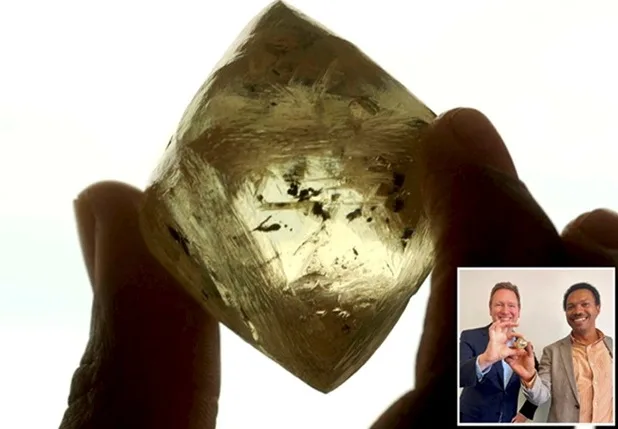
Fifty years have elapsed since the recovery of the world’s largest octahedral diamond, a remarkable 616-carat Type 1 yellow diamond. Originating from the Dutoitspan Mine in Kimberley, South Africa, the diamond remains untouched, unpolished, and unsold, preserving its legacy spanning generations.
Discovered on April 17, 1974, by De Beers employee Abel Maretela, the diamond’s find led to significant rewards for Maretela, including a substantial bonus and a house. Al Cook, CEO of the De Beers Group, had the privilege of viewing the diamond during a visit to Johannesburg, hosted by Moses Madondo, CEO of De Beers Group managed operations. Cook expressed his fascination with diamond history, highlighting the Type 1 classification of the diamond, indicating its formation deep within the Earth’s mantle over a billion years ago.
The diamond’s striking yellow hue, attributed to trapped nitrogen atoms, further adds to its allure, offering a glimpse into Earth’s geological history.
Photo credits: De Beers
Disclaimer: Jewel Bharat aims to provide accurate and reliable information. Readers are encouraged to contact@jewelbharat.com to report any concerns regarding the content. Appropriate corrective measures, including potential removal of the article from the website, will be taken following investigation.
Related Coverage

IIGJ Mumbai Celebrates 79 Graduates, Showcasing Innovation and the Future of Jewellery Design

UNNATI: Building the Women Who Will Shape India’s Jewellery Future

GJS 2026 Diwali Edition to Bring 400+ Exhibitors to Mumbai from October 2–4

GJEPC Holds 60th AGM, Reviews FY2025-26 Performance and Industry Priorities

De Beers’ 2025 Sustainability Report Signals Where the Natural Diamond Industry Is Heading