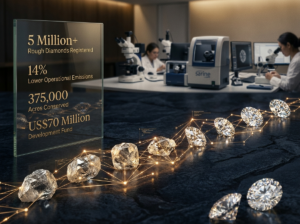


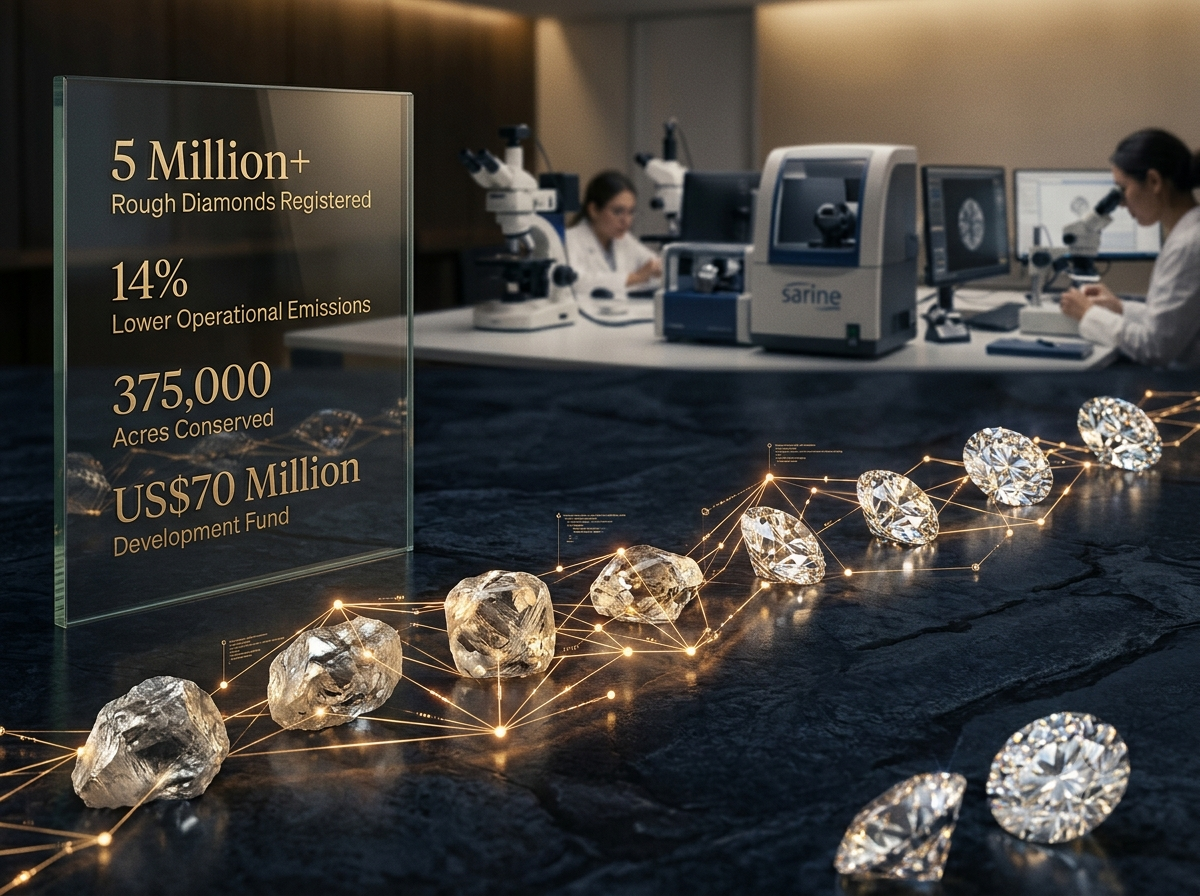
Tracr crosses five million rough diamonds, carbon emissions fall 14%, and Botswana receives a US$70 million development commitment as De Beers advances its Building Forever goals.
Key Highlights
- Tracr surpassed 5 million individually registered rough diamonds.
- De Beers reduced Scope 1 and 2 emissions by 14% since 2021.
- 375,000 acres are now managed for conservation.
- Angola’s first Ramsar Wetland designation protects the Okavango Delta’s water source.
- US$70 million committed to Botswana’s Diamonds for Development Fund.
- EntreprenHER has trained 3,900+ women since 2016.
- The company supported 2.6 offsite jobs for every onsite job created.
- 2025 became the safest year in De Beers’ history, with zero work-related fatalities.
As global buyers place greater emphasis on provenance, sustainability and responsible sourcing, De Beers Group’s 2025 Sustainability Report offers a clear indication of the priorities shaping the future of the natural diamond industry.
Published under the company’s Building Forever framework, the report details progress across four major pillars—Livelihoods, Nature, Climate and Provenance—while highlighting milestones that have implications for the wider global diamond value chain, including India’s manufacturing and export ecosystem.
Among the report’s standout developments are the registration of more than five million rough diamonds on Tracr, a 14% reduction in Scope 1 and 2 carbon emissions since 2021, conservation management across 375,000 acres of land in Southern Africa, and a US$70 million commitment to Botswana’s Diamonds for Development Fund.
Tracr Passes Five Million Diamonds
One of the report’s most significant milestones is the continued expansion of Tracr, De Beers’ blockchain-backed diamond traceability platform.
The platform has now surpassed five million individually registered rough diamonds, strengthening transparency across the natural diamond supply chain.
During 2025, Tracr also established a new partnership with Sarine, integrating rough diamond source registration with advanced scanning technology to create a more cost-effective end-to-end traceability solution.
The platform additionally served as the traceability backbone for a De Beers London capsule collection featuring GemFair diamonds, demonstrating how artisanally mined diamonds can be purchased with greater transparency.
For India’s manufacturers, exporters and retailers, the continued expansion of traceability reflects the growing international importance of provenance in premium diamond markets.
Climate Targets Continue to Advance
The report shows continued progress towards De Beers’ science-based climate targets.
Since 2021, the company has reduced its Scope 1 and 2 carbon emissions by 14%, moving towards its objective of reducing emissions by one-third by 2030.
The company also highlighted several initiatives supporting lower-carbon operations, including:
- Support for Envusa’s 520MW renewable energy project combining solar and wind power.
- Trials involving biofuels.
- Tyre circularity initiatives with Anglo American and Sasol.
- Investment in Kelp Blue’s large-scale giant kelp restoration project in Namibia.
Future priorities include expanding renewable energy capacity, electrifying mining equipment and addressing Scope 3 emissions through supplier engagement.
Conservation Beyond Mining
Nature conservation remains one of De Beers’ largest long-term commitments.
According to the report, the company now manages 375,000 acres of land for conservation across Southern Africa while pursuing nature-positive initiatives across its operations.
A major achievement during the year was supporting the designation of Angola’s first Ramsar Wetland through the Okavango Eternal partnership with National Geographic, helping protect the source of approximately 95% of the water flowing into the Okavango Delta.
The report also highlights conservation work in Botswana, where the birth of the 70th rhino calf was recorded on De Beers-managed reserves, alongside the successful translocation of 31 rhinos as part of wider rewilding efforts.
Investing in Communities
The sustainability report places considerable emphasis on livelihoods across diamond-producing countries.
Among the year’s key developments:
- The Stanford Seed programme has now supported 128 businesses through leadership training and business development.
- The EntreprenHER programme, delivered with UN Women, trained another 500 women during 2025, bringing the total to more than 3,900 women since 2016.
- De Beers supported 2.6 offsite jobs for every onsite job created during the year.
The company also announced an initial investment of BWP1 billion (approximately US$70 million) into Botswana’s newly established Diamonds for Development Fund, aimed at supporting long-term economic diversification and knowledge-based industries.
Safety Records Reach a New Milestone
The report also notes that 2025 became the safest year in De Beers Group’s history, recording:
- A 19% reduction in Total Recordable Injury Frequency Rate compared with 2024.
- Zero work-related fatalities.
Al Cook: “Natural Diamonds Can Do More Than Sparkle”
Al Cook, Chief Executive Officer of De Beers Group, said:
“At De Beers, we believe natural diamonds can do more than sparkle. Through the natural diamond value chain, they can support jobs, skills development, nature conservation and climate action in diamond-producing countries. During 2025, De Beers Group sharpened its focus on a set of ambitious sustainability targets where the business can make the greatest difference, aligned with partner country priorities, global standards and UN Sustainable Development Goals. We are proud of the progress we are making to ensure every diamond we recover creates lasting impact for people, communities and the environment, but we also understand that this requires sharp focus, deliberate action and constant monitoring. As the pace of change around us increases, and as the risks and opportunities ahead of us become clearer, so must our commitment to progress grow.”
Sandrine Conseiller: Sustainability Is Becoming a Consumer Expectation
Sandrine Conseiller, CEO, De Beers Brands, added:
“We’re pleased to share our 2025 sustainability achievements, demonstrating that our ambitions can lead to real, impactful change. Consumers increasingly expect the brands they choose to consider their wider impact, not as something exceptional, but as a matter of course. This report is about showing what De Beers’ sustainability commitments mean in practice, sharing openly the actions we are taking and the impact we are having, so customers can choose natural diamonds with confidence, knowing the value they create reaches far beyond the diamond itself.”
Why It Matters for India
Although many of the report’s initiatives focus on Botswana, Namibia, South Africa and Angola, the broader themes are increasingly relevant for India.
As the world’s largest diamond manufacturing centre, India is becoming more closely connected with international expectations around traceability, responsible sourcing, sustainability reporting and consumer transparency.
The continued expansion of Tracr, stronger provenance systems and responsible sourcing frameworks indicate where future global standards are evolving—developments that exporters, manufacturers and retailers across India’s diamond ecosystem will continue to monitor closely.
Related Coverage

IIGJ Mumbai Celebrates 79 Graduates, Showcasing Innovation and the Future of Jewellery Design

UNNATI: Building the Women Who Will Shape India’s Jewellery Future

GJS 2026 Diwali Edition to Bring 400+ Exhibitors to Mumbai from October 2–4
GJEPC Holds 60th AGM, Reviews FY2025-26 Performance and Industry Priorities

Mehul Shah Unveils Eight-Point Roadmap to Strengthen the Global Natural Diamond Industry at JGW Hong Kong 2026